Practice at home
How to Wear a Sari
Step-by-step instructions, with pictures, for draping a sari in the everyday style worn by devotees
A sari is a single length of cloth, usually five to six meters, worn over a petticoat and a fitted blouse. Women devotees wear it for worship and, when practical, every day. It looks complicated but is easy after a few tries. These are the eight steps for the most common drape, with the pleats in front and the end piece over the left shoulder.
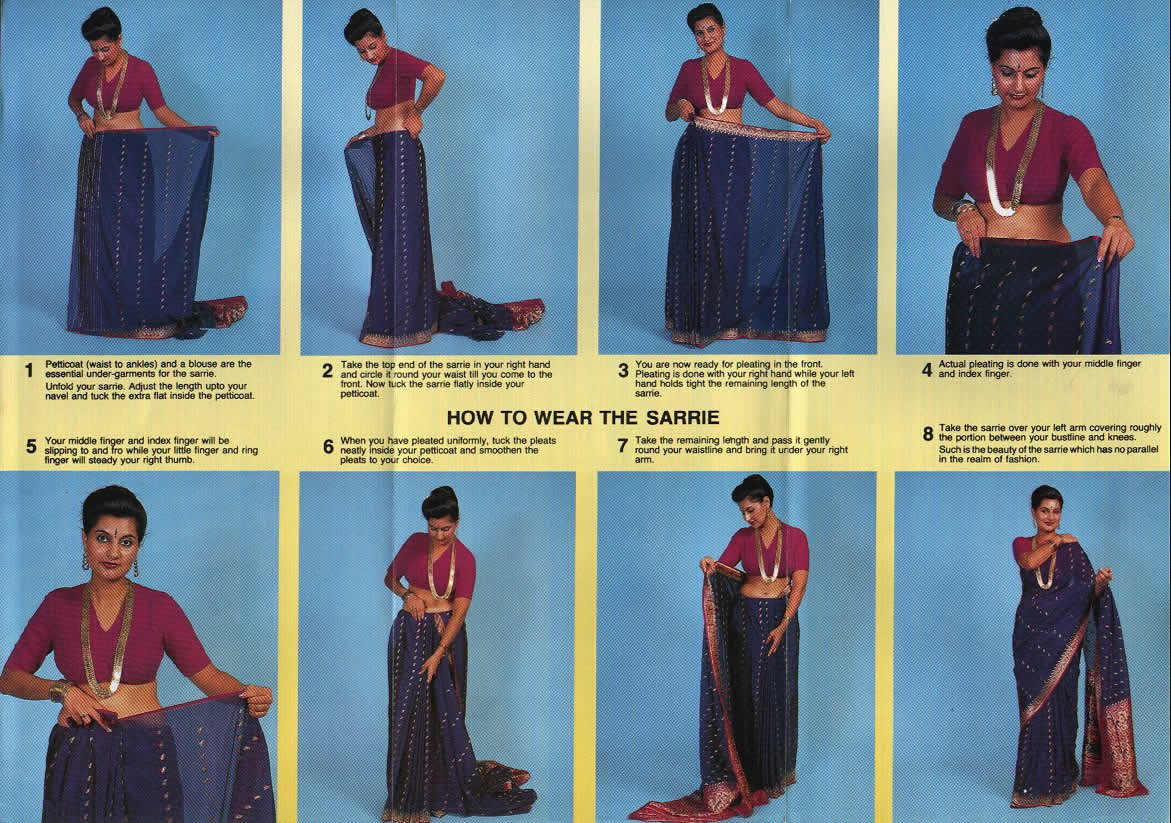
- A petticoat, tied at the waist and reaching the ankles, and a blouse are the essential undergarments. Unfold the sari. Adjust the length up to your navel and tuck the extra cloth flat inside the petticoat.
- Take the top end of the sari in your right hand and circle it round your waist until you come to the front. Tuck the sari flatly inside the petticoat.
- You are now ready for pleating in the front. Pleating is done with the right hand while the left hand holds the remaining length of the sari taut.
- Make the pleats with your middle finger and index finger, each pleat about a hand's width.
- Your middle finger and index finger slip to and fro while your little finger and ring finger steady your right thumb. Make five to seven even pleats.
- When you have pleated uniformly, tuck the pleats neatly inside your petticoat, just left of the navel, and smooth them so they fall straight.
- Take the remaining length and pass it gently round your waistline, bringing it under your right arm.
- Take the sari over your left shoulder, covering roughly the portion between your bustline and knees. Let the end piece, the pallu, fall down your back, or pin it at the shoulder to keep it in place.
For worship, the head is covered by drawing the pallu up over the hair. Choose cotton for daily wear and cooking, and keep a clean sari set aside for the altar. The Krishna Store carries saris and gopi dresses suited to devotees.